Buyers shopping for air pillows almost always get stuck on the same two questions, and neither is about branding. The first is how many they will actually go through, which decides whether pre-inflated bags or an on-demand machine makes sense. The second is which pillow, since film gauge and pillow size change how well a shipment survives the truck. Answer both with a little arithmetic and a few specifications, and the guesswork disappears.
Fill the void, do not just cover the product
The job of an air pillow is to eliminate empty space so the product cannot move. A box that rattles is a box that fails, because movement lets a corner find a wall and concentrate the impact. The working rule is to leave no gap a product can shift into, and for fragile goods to build roughly two inches of cushioning between the item and every inside face of the carton. That means picking a box only slightly larger than the product where you can, then filling what remains completely rather than dropping a token handful of pillows on top. Under-filling is the single most common and most expensive mistake, because it looks fine on the packing bench and only reveals itself as a damage claim.
Estimating how many pillows you will actually use
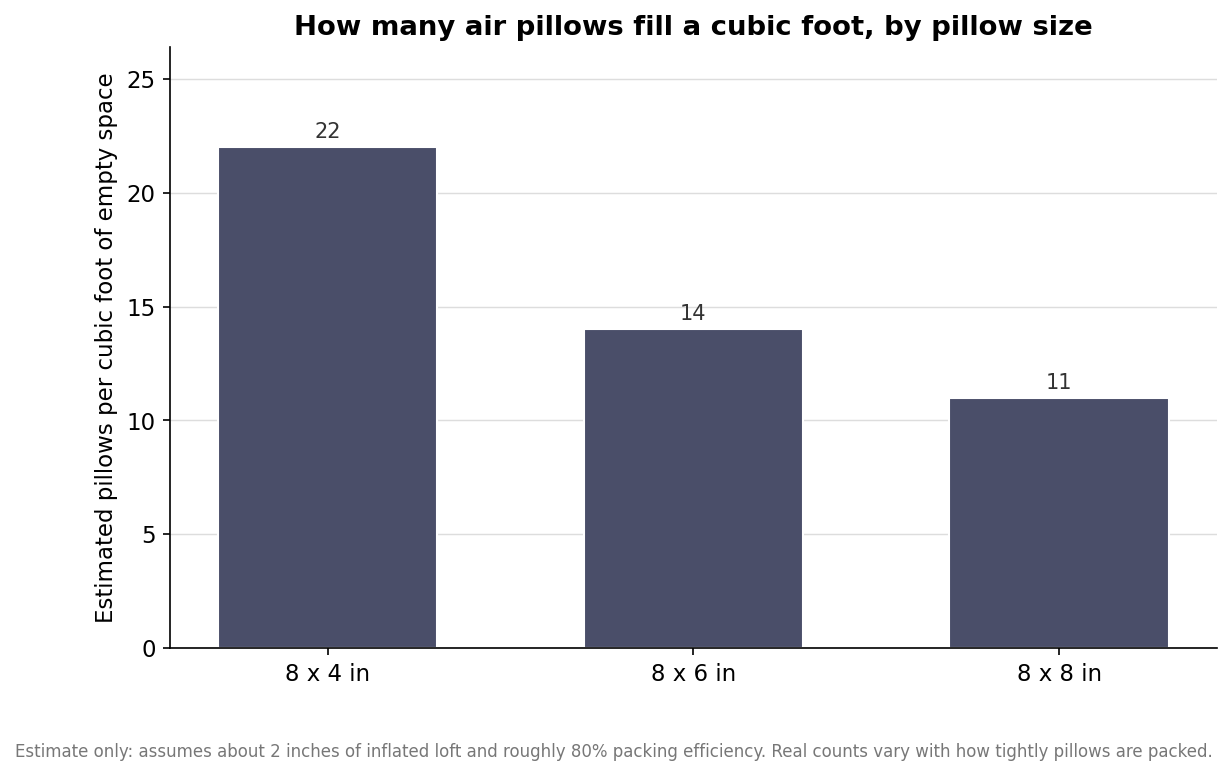
The quantity you need starts from the empty space, not the product. Take the interior volume of your carton and subtract the volume of the item inside it; what is left is the void you have to fill. Air pillows come in a small set of standard footprints, commonly around eight by four inches, eight by six, and eight by eight, and the smaller the pillow the more of them a given space swallows. As a planning estimate, a cubic foot of empty space takes on the order of twenty of the smallest pillows or roughly ten of the largest, assuming they inflate to about two inches thick and pack reasonably tightly. Treat those as ballpark figures for ordering, then confirm against your own boxes, because how firmly your team packs the void changes the real count.
Choosing film gauge and pillow size
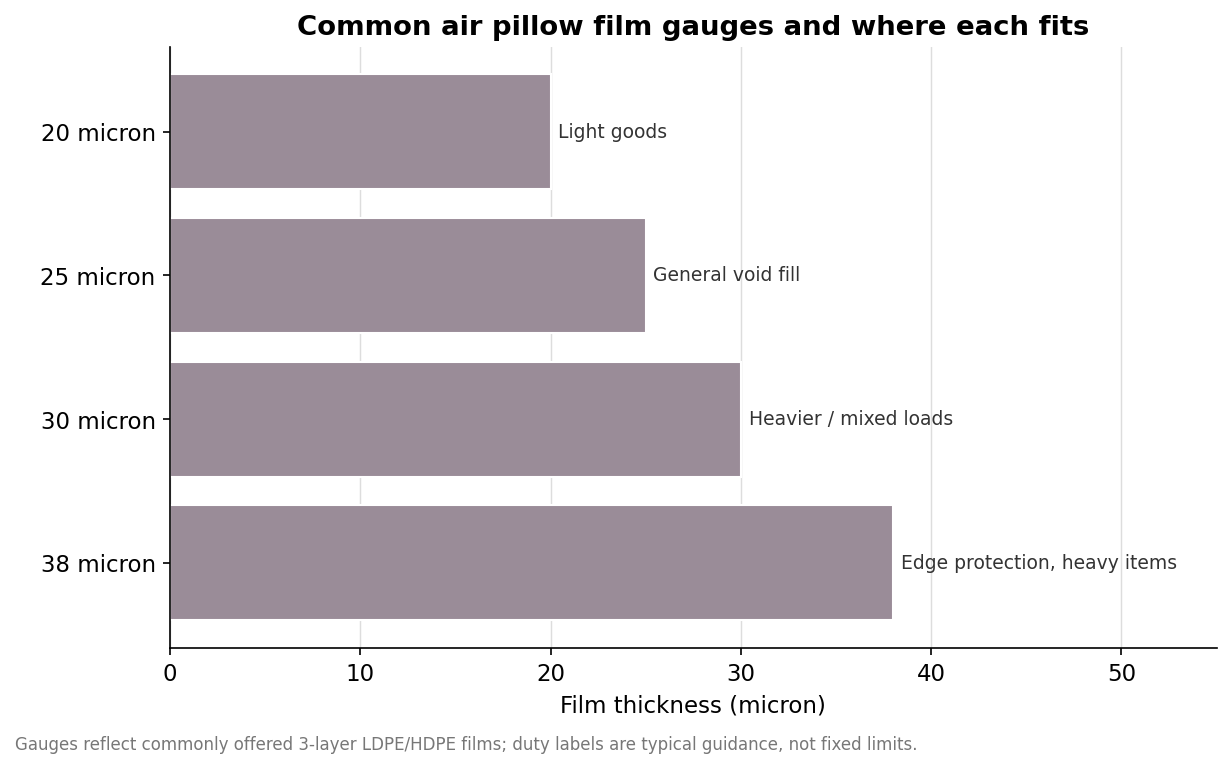
Film thickness is where protection is won or lost. Air pillow film is typically a three-layer blend of LDPE and HDPE offered in gauges around 20, 25, 30, and 38 micron. Lighter 20 to 25 micron film is fine for light, non-fragile goods and general top-fill, while 30 and 38 micron films resist puncture better and hold up against corners, edges, and heavier items that would split a thin pillow. Match the pillow footprint to the gap as well: large eight-by-eight pillows fill big voids quickly around a small central product, while smaller pillows tuck into the narrow channels along a box’s sides where a large one would only bridge the gap and leave space beneath it. A shipment that mixes a couple of sizes usually packs tighter than one that relies on a single pillow for everything.
On-demand machines versus pre-inflated bags
How you buy the air depends entirely on volume. Air pillow film ships as flat rolls, commonly a few hundred to well over a thousand meters long, and inflates on demand at the packing station at roughly 30 to 40 feet per minute. The appeal is storage: flat film takes a fraction of the room that pre-inflated pillows do, since you are not paying to warehouse and ship air until you need it. The cost of the material itself is low once you are running, on the order of one to three cents per cubic foot of fill, but an inflation machine is a real outlay, commonly in the range of fifteen hundred to five thousand dollars. That math favors an on-demand setup for anyone shipping steadily, while a low-volume shop is usually better served by buying pre-inflated pillows by the case and skipping the equipment entirely. It helps to translate a roll into pillows before you buy: a single roll of small eight-by-four film can run well over a thousand linear feet and yield in the neighborhood of several thousand finished pillows, so one roll often covers weeks of moderate shipping. Working out your weekly pillow count first, then dividing into a roll’s yield, tells you how much film to keep on the shelf and how often you will reorder.
The two catches worth planning around
Air pillows are not flawless, and two realities deserve a place in your plan. The first is deflation: a small share of pillows, often cited in the range of five to eight percent, arrive at the destination softer than they left, largely because temperature and pressure swings in transit work on the seams, and high-altitude routes are the worst offenders. The practical response is to fill firmly rather than to the minimum, so a little lost pressure still leaves the product immobilized. The second is disposal. These pillows are generally LDPE, which is recyclable, but through store drop-off programs for plastic film rather than most curbside bins, so it is worth telling customers where the material actually goes. Custom printing can carry that message directly on the pillow, turning a disposal instruction into a small brand touch.
Put together, an air pillow order comes down to a short sequence: measure the void you need to fill, estimate pillow counts from the space rather than the product, pick a film gauge that matches how rough the journey and the contents are, choose on-demand or pre-inflated based on your shipping volume, and fill firmly enough that a few soft pillows still hold everything still. Get that sequence right and the pillows do their quiet job, which is to make sure nothing inside the box ever moves.
Leave a Reply